Short answer: Yes, for now. On Monday, Nov. 9, 2026, the U.S. Supreme Court paused a federal judge’s order that had stopped border wall construction in the Big Bend region of West Texas, so the Department of Homeland Security can resume work while the legal fight continues. The ruling in Mullin v. Friends of the Ruidosa Church is temporary, not a final decision on whether the project is lawful, but its reasoning makes it very hard for the challengers to win in their current form.
Here is what the court actually decided, why a single law gives the government such unusual power to build border barriers, and what could happen next.
What did the Supreme Court decide?
In a short, unsigned (per curiam) opinion, the justices granted the government’s request to stay a preliminary injunction issued by the U.S. District Court for the Western District of Texas. Justice Ketanji Brown Jackson noted that she would have denied the request but did not explain why. You can read the full opinion on the Supreme Court’s website.
Two details matter:
- The court did not reverse the judge outright. According to SCOTUSblog, the government asked for summary reversal (a ruling on the merits without full briefing or argument), and the justices declined that part of the request.
- The pause has an expiry date built in. The stay lasts while the government files a petition for review (certiorari) and the court decides it. If the court denies review, the stay ends automatically. If it grants review, the stay lasts until the court issues its final judgment.
In practical terms, the Texas Tribune reports that construction can resume while the administration seeks further Supreme Court review.
How the Big Bend border wall case started
Earlier in 2026, the Secretary of Homeland Security used a 1996 law to start a construction project in what U.S. Customs and Border Protection calls the “Big Bend Sector.” The secretary found the sector to be “an area of high illegal entry” and waived a range of environmental and conservation laws to speed construction, according to the court’s opinion. SCOTUSblog reports that three waivers were issued, first by then-Secretary Kristi Noem and then by her successor, Markwayne Mullin, and that the area includes parts of Big Bend National Park.
Three plaintiffs sued: an individual river guide, an environmental nonprofit, and a nonprofit dedicated to preserving a historic church in Ruidosa, Texas. On Oct. 2, 2026, U.S. District Judge Kathleen Cardone issued a preliminary injunction that blocked the waivers and halted the associated construction.
Judge Cardone relied on the major questions doctrine, the idea that when an agency claims power to make decisions of vast economic or political significance, Congress must have authorized it clearly. As SCOTUSblog summarized her written opinion, she noted that the Big Bend Sector makes up more than 25% of the U.S.-Mexico border but only a small share of migrant apprehensions (between 0.3% and 2.2%), and reasoned that if Big Bend counts as an area of high illegal entry, the limit in the law would mean little.
The law at the center: IIRIRA Section 102
The dispute turns on Section 102 of the Illegal Immigration Reform and Immigrant Responsibility Act of 1996 (IIRIRA). As the Supreme Court described it, the section does three unusual things:
- It authorizes border barriers and roads “to deter illegal crossings in areas of high illegal entry into the United States.”
- It lets the Homeland Security secretary “waive all legal requirements” the secretary determines are necessary “to ensure expeditious construction” of those barriers and roads. That can include environmental-review and conservation laws that would normally apply to a federal project.
- It sharply limits lawsuits. A claim challenging a waiver “may only be brought alleging a violation of the Constitution of the United States,” and courts “shall not have jurisdiction” over other claims. The law also cuts out the regular federal appeals court; review goes straight to the Supreme Court, which is why this case skipped the Fifth Circuit.
That combination is why border wall challenges are so hard to win. If you cannot argue that a waiver violated the Constitution, a federal district court generally cannot hear the case at all. For background on how immigration rules are shaped by Congress and the courts, see our guide to immigration laws and changing policies.
Why the Supreme Court sided with the government
“No such thing as a constitutional major-questions claim”
The challengers framed their claim as constitutional, arguing that the waivers violated the major questions doctrine “under the U. S. Constitution, Article I, Section 1.” Judge Cardone accepted that framing, describing the doctrine as a constitutional clear-statement rule grounded in the separation of powers.
The Supreme Court disagreed. It said the claim, however it is labeled, really alleges that the secretary exceeded his statutory authority, and it cited its 1994 decision in Dalton v. Specter for the rule that claims “simply alleging” that the executive branch went beyond its statutory power are not constitutional claims. The court acknowledged that many interpretive rules reflect constitutional principles, but said courts use them to decide statutory questions. Its bottom line: “There is no such thing as a ‘constitutional’ major-questions claim.” Because the law only allows constitutional claims, the court found the government “exceedingly likely” to win on its argument that the district court lacked jurisdiction.
Cost, border security and the balance of harms
A stay also requires looking at harm. The court said the injunction delayed construction and impeded the government’s “compelling interests” in border security. It also pointed to a declaration from a CBP official saying the government was incurring nearly half a million dollars in costs per day because of the injunction, money that could not be recovered later.
On the other side of the scale, the challengers said construction would hurt their ability to use and enjoy the area. The court responded that by passing Section 102(c), Congress showed “a clear preference for expeditious border construction over the very harms respondents assert,” and concluded that the government’s interest “outweighs any aesthetic, recreational, and environmental harm alleged by respondents.”
What the ruling means, and what it doesn’t
- Construction can resume now. The district court’s order is on hold.
- It is not the end of the case. The Texas Tribune notes the ruling is temporary while the case moves forward. The government still has to seek certiorari, and the court has not ruled on the merits after full briefing.
- The reasoning is a strong signal. By saying a major-questions argument is a statutory claim, the court has signaled that challengers who rely on that doctrine are unlikely to get past IIRIRA’s limit on lawsuits. Any future challenge would likely need a claim that is genuinely constitutional.
- It does not decide whether Big Bend is truly “an area of high illegal entry.” The court’s opinion focused on jurisdiction and the stay factors, not on the facts behind the secretary’s finding.
Reaction has been sharp. AP reports that landowners, business owners in the region and environmental groups who opposed the project were bitterly disappointed, and USA Today quoted the Center for Biological Diversity calling it a “horrific decision.”
Why this matters beyond Texas
The case is a clear example of how much power Congress can hand to the executive branch when it also limits judicial review. Environmental laws normally give the public a way to challenge federal projects, but a waiver statute like Section 102 can switch those laws off for a specific project. Our explainer on environmental law and legal actions covers how those challenges usually work.
It also adds to a run of emergency-docket rulings in which the Supreme Court has used stays to let federal policies take effect while litigation continues. For context on earlier rulings, see our overview of landmark Supreme Court decisions from 2025.
FAQ
Did the Supreme Court approve the Big Bend border wall?
Not in a final sense. It paused the lower court’s injunction, which allows construction to resume while the government seeks full Supreme Court review.
What was the vote?
The opinion was unsigned. Justice Jackson was the only justice to note that she would have denied the government’s request, which news outlets describe as an 8-1 ruling.
What is the major questions doctrine?
It is a principle courts use when reading statutes: if an agency claims power over a question of vast economic or political significance, the court expects clear authorization from Congress. In this ruling, the Supreme Court said it is a tool of statutory interpretation, not a source of constitutional claims.
Can the government ignore environmental laws when building a border wall?
Under IIRIRA Section 102, the Homeland Security secretary can waive legal requirements, including environmental and conservation laws, that the secretary determines are necessary for expeditious construction of border barriers and roads in areas of high illegal entry. Challenges are limited to constitutional claims.
What happens next?
The next step is for the government to file a petition for certiorari asking the court to take the case. If the court denies it, the stay ends automatically; if the court takes the case, the stay stays in place until a final judgment.
This article is for general information only and is not legal advice. Court rulings and project plans can change quickly; check the latest official sources for current status.
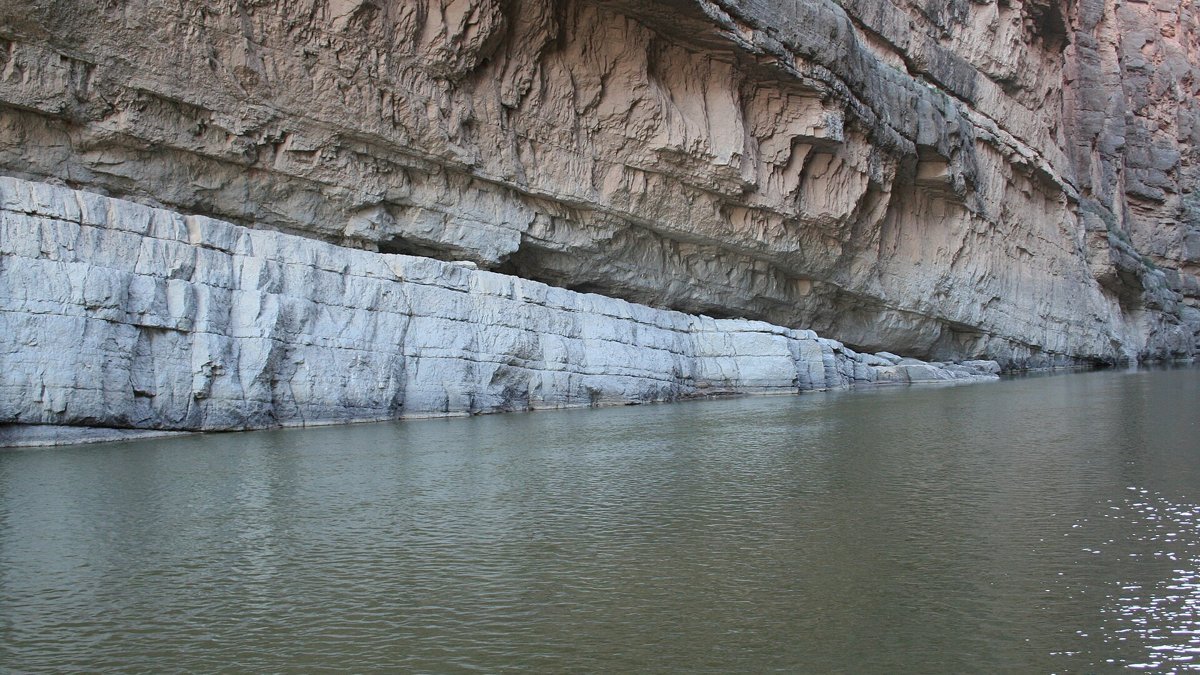
Featured image: Santa Elena Canyon and the Rio Grande in Big Bend National Park, Texas. Photo by Leaflet via Wikimedia Commons, public domain, cropped.