Short answer: No, not in this case. On Nov. 23, 2026, New York’s highest court, the Court of Appeals, ruled 4-3 in Patterson v. Meta Platforms that survivors and families of victims of the May 14, 2022, Tops supermarket shooting in Buffalo cannot pursue their product-liability lawsuits against Meta, Instagram, Snap, Google, YouTube, Reddit, Discord, Twitch, Amazon and 4chan. The majority did not say social media companies can never be sued over how their apps are designed. It held that these complaints failed to show the shooter’s attack was a “natural and foreseeable consequence” of the platforms’ design choices, and it expressly declined to decide how far Section 230 of the Communications Decency Act protects the companies. Here is what the court decided, why three judges dissented and what the ruling means for other social media cases.
What the Buffalo Social Media Lawsuits Claimed
The shooter killed 10 people and injured three others at the Tops Friendly Markets store on Buffalo’s East Side in a racially motivated attack. Victims and family members filed four consolidated lawsuits in state court against the shooter’s parents, several gun and equipment companies, and a group of social media companies. Only the claims against the social media companies were before the Court of Appeals.
According to the court’s opinion, the plaintiffs framed their case as product liability, not as a complaint about speech. They argued the platforms were defectively designed to be addictive, using features such as infinite scroll, push notifications and engagement-driven recommendation algorithms, and that the companies failed to warn users and parents about the risks. Their theory was that this design drew the shooter, then a teenager, into compulsive use that helped radicalize him.
That framing matters because of 47 U.S.C. § 230, which says no online service “shall be treated as the publisher or speaker” of information provided by someone else. The families acknowledged that the racist content itself is protected speech and that Section 230 bars liability for publishing it. They argued their claims targeted the companies’ own product design instead.
How the Case Reached New York’s Top Court
The trial court, the state Supreme Court in Erie County, denied the companies’ motions to dismiss, finding the complaints adequately pleaded product-liability claims and that it was “far too early” to decide causation as a matter of law. In 2025, the Appellate Division, Fourth Department, reversed in a 3-2 decision. Its majority held the companies were immune under Section 230, reasoning that the claims depended on the content the shooter consumed, and it also found the complaints did not adequately allege proximate cause. The plaintiffs then appealed to the Court of Appeals.
What the Court of Appeals Decided
The court affirmed the dismissals in a short unsigned memorandum joined by Judges Michael Garcia, Madeline Singas, Anthony Cannataro and Caitlin Halligan. It split the defendants into two groups.
Twitch, Discord, Amazon and 4chan
For these defendants, the court said the plaintiffs did not allege that the platforms had any of the addictive features that the plaintiffs said put their claims outside Section 230. So the court saw “no reason to disturb” their dismissal.
Meta, Instagram, Snap, Google, YouTube and Reddit
For the larger platforms, the court rested on proximate cause, the tort-law requirement that a defendant’s conduct be a substantial and foreseeable cause of the injury. Under New York precedent, an unforeseeable intervening criminal act can break the chain of causation. The majority wrote that, even accepting the allegations as true, the complaints “fail to establish that the shooter’s actions were a natural and foreseeable consequence” of the companies’ design decisions, and that his actions “were so extraordinary as to sever the causal chain as a matter of law.”
Two limits stand out. The majority said it “need not address the scope of section 230,” and a footnote says its conclusion “is limited to the unusual facts of this case,” where the allegedly addictive features harmed the shooter rather than the plaintiffs directly. If you want background on where platform responsibility generally begins and ends, our guide to the legal side of social media for users and platforms covers the basics.
The Concurrence: Addictive Design Claims May Survive Elsewhere
Judge Halligan joined the majority but wrote separately, and her opinion may matter as much as the holding. She agreed with the dissent that the complaints alleged several defendants designed addictive products, and that claims about designing features to encourage addiction, “irrespective of the particular content,” are not barred by Section 230 because that is not a traditional editorial function. She wrote she had “little doubt” a plaintiff could allege a sufficient link between platform design and harm to young users’ mental health, citing the Massachusetts high court’s 2026 decision in Commonwealth v. Meta Platforms.
Her line was causation. Here, she noted, the plaintiffs were not users but victims of a crime by a user, and the content itself was a necessary link in the chain. She also noted the platforms have billions of users, warning that otherwise “the concept of proximate cause would have little meaning.” On algorithms, she said she was skeptical that individualized recommendation systems are a traditional publisher function, but called the overall Section 230 question “difficult” and left it open.
The Dissent: “Slam the Courthouse Door”
Judge Jenny Rivera, joined by Chief Judge Rowan Wilson and Judge Shirley Troutman, dissented in part. She argued that Section 230 does not shield a company’s “own tortious actions, including designing a defective product and failure to warn,” and that under New York’s liberal pleading rules the claims against several companies should have gone forward. “No federal or state law requires that we slam the courthouse door on plaintiffs’ claims,” she wrote. She agreed the claims against Twitch, Discord and 4chan were properly dismissed. As Reuters reported, Rivera said a jury should decide whether the companies were on notice that their products could contribute to such violence.
The split reflects the wider national debate over whether recommendation feeds are protected editorial choices or a product feature like any other, a tension also explored in our piece on freedom of speech vs. online regulation.
What the Ruling Means
- For the Buffalo families: The claims against the social media companies are over in New York state court unless a further appeal succeeds. Matthew Bergman, a lawyer for one plaintiff family, said his clients are evaluating their legal options, according to Reuters. The separate claims against the gun companies and the shooter’s parents were not part of this appeal.
- For other social media addiction lawsuits: The ruling does not decide cases brought by users who say they were harmed directly by addictive design, such as the youth mental-health suits pending around the country. The concurrence suggests those claims stand on different footing.
- For Section 230: New York’s top court left open how far the law protects algorithms and design features. That question remains unsettled across state and federal courts.
It is another closely divided ruling from New York’s top court, which also split 4-3 in its recent Section 8 discrimination ruling for New York renters.
FAQ
Did the court rule that Section 230 protects social media companies?
No. The majority said it did not need to address Section 230 for Meta, Snap, Google, YouTube and Reddit because the claims failed on proximate cause. The lower appeals court had relied on Section 230, but the top court affirmed on causation instead.
Can social media companies be sued for addictive design in New York?
The ruling does not rule that out. The majority limited its holding to these “unusual facts,” and the concurring judge and three dissenting judges all agreed that claims based on addictive design, separate from content, are not barred by Section 230. A future case involving a directly injured user could come out differently.
What is proximate cause?
It is the legal requirement that a defendant’s conduct be a substantial, foreseeable cause of the harm. A highly unusual intervening act, such as a planned crime by a third party, can break that link.
Can the families appeal to the U.S. Supreme Court?
The U.S. Supreme Court generally reviews state-court decisions only on federal questions. Because the majority rested on state tort-law causation rather than Section 230, that path is narrow.
This article is general information about a court decision, not legal advice. If you are considering a claim against an online platform, talk with a licensed attorney in your state.
Sources: New York Court of Appeals, Patterson v. Meta Platforms, Inc., Nos. 68-71 (decided Nov. 23, 2026); Reuters (Nov. 23, 2026); The Volokh Conspiracy (Nov. 23, 2026); 47 U.S.C. § 230.
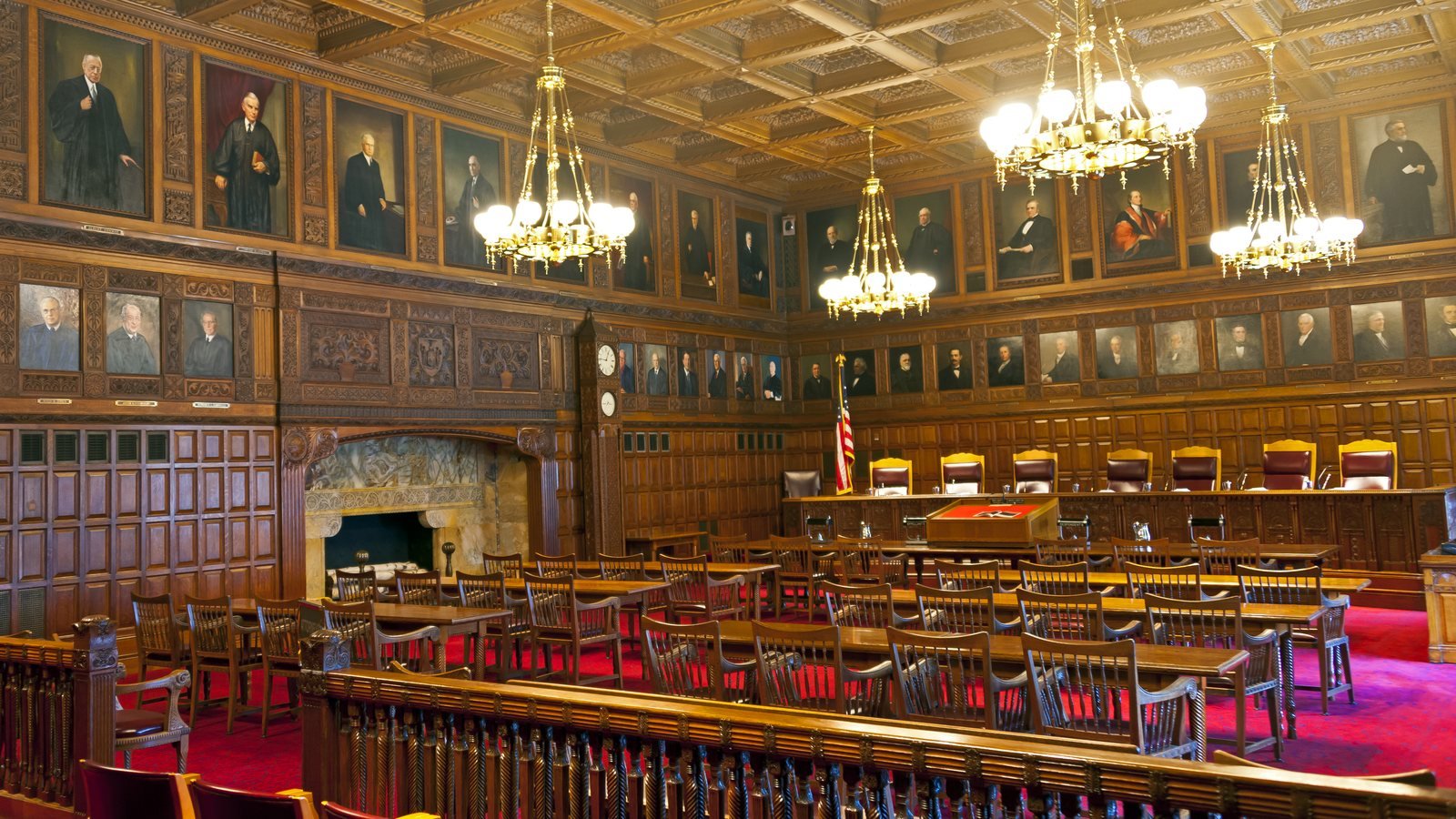
Featured image: Courtroom of the New York Court of Appeals, Albany. Photo by Daniel Case via Wikimedia Commons, CC BY-SA 3.0, cropped.