Quick answer: Hoffmann v. WBI Energy Transmission asks a narrow but costly question: when a private natural gas pipeline company uses federal eminent domain to take an easement across someone’s land, does it have to follow the compensation rules of the state where the land sits? For a family of North Dakota ranchers, the answer decides whether the pipeline company or the landowners pay roughly $300,000 in legal fees. The U.S. Supreme Court is scheduled to hear arguments on Monday, November 9, 2026, with a decision expected by the end of the term.
What is Hoffmann v. WBI about?
WBI Energy Transmission, Inc. transports and stores natural gas. To build a pipeline through McKenzie County in western North Dakota, it obtained a certificate of public convenience and necessity from the Federal Energy Regulatory Commission (FERC) and then tried to buy the easements it needed. When the Hoffmann family and neighboring landowners would not sell on WBI’s terms, the company filed a federal condemnation case under the Natural Gas Act.
According to a case summary published by the North Dakota Court System, the parties eventually agreed on the amount of compensation for the easement after about three years of negotiations. One issue remained: who pays the landowners’ attorney fees?
The Institute for Justice, which represents the landowners, says those fees came to roughly $300,000. Under North Dakota law, a condemning party can be required to pay a property owner’s attorney fees in eminent domain cases. The federal district court applied that rule and ordered WBI to pay.
What the Eighth Circuit decided
On March 24, 2025, a three-judge panel of the U.S. Court of Appeals for the Eighth Circuit vacated the fee award. Writing for the panel, Judge David Stras began: “Attorney fees are typically unavailable when the United States exercises its eminent-domain power. Nothing changes when the federal government delegates the power to a private party under the Natural Gas Act, so we vacate the award of fees in this case.”
The court reasoned that the Natural Gas Act says nothing about how compensation is measured, so the Fifth Amendment’s “just compensation” standard fills the gap. Under longstanding Supreme Court precedent, including United States v. Bodcaw Co. (1979), constitutional just compensation generally does not include the owner’s legal fees unless Congress specifically provides for them.
The Supreme Court agreed to hear the landowners’ appeal on June 29, 2026, according to the official docket for case No. 25-159.
The legal question in plain English
The statute at the center of the case is 15 U.S.C. § 717f(h). It lets the holder of a FERC certificate acquire a pipeline right-of-way “by the exercise of the right of eminent domain” in federal or state court when it cannot reach a deal with the owner. It does not say whether federal or state law decides how much the owner must be paid.
As SCOTUSblog’s argument preview frames it, the issue is “whether just compensation here should be determined by referring to state law.”
The landowners’ argument
- WBI is a private company, not the United States, and private companies normally have to follow the law of the state where they operate.
- Because Congress was silent on compensation, courts should borrow state law as the rule, an approach associated with United States v. Kimbell Foods.
- Fair market value alone can leave owners worse off. The Institute for Justice gives the example of an owner who spends $50,000 in legal costs to get paid for a $200,000 home.
- In 1883, in United States v. Jones, the Supreme Court described the “right of eminent domain” as the power to take property, not as a built-in rule about how compensation is measured.
WBI’s and the federal government’s argument
- WBI’s power to condemn comes from federal law, so it should stand in the federal government’s shoes and owe only what the Constitution requires.
- A 1946 law, the General Bridge Act, expressly said compensation would be paid “according to the laws of [the] State.” The Natural Gas Act’s eminent domain provision, added in 1947, contains no similar language.
- In United States v. Miller (1943), the Court applied federal compensation standards under an earlier statute with similar wording.
- The U.S. Solicitor General, who will share argument time with WBI, warns that applying state rules could let states burden federally approved projects they dislike.
SCOTUSblog’s Ronald Mann also flags a practical hurdle for the landowners: the Supreme Court generally does not award attorney fees under a federal statute without a clear statement from Congress, and some justices may hesitate to require fees under a law that never mentions them.
Why the case matters beyond North Dakota
Federal appeals courts are split. According to analyses by Marten Law and a preview from a property rights firm that filed an amicus brief, the Third, Fifth, Sixth and Eleventh Circuits have looked to state law in Natural Gas Act condemnations, while the Eighth Circuit applied the federal standard. Right now, what a landowner can recover may depend on which part of the country the land is in.
The case has drawn a wide range of friend-of-the-court briefs. The State of North Dakota, the National Association of Realtors, the American Farm Bureau Federation and several landowner groups filed in support of the property owners. The U.S. Chamber of Commerce, the Interstate Natural Gas Association of America and the American Petroleum Institute filed on WBI’s side.
The ruling could also affect state protections beyond attorney fees. The Institute for Justice argues that if federal standards control, other state-law protections, such as special treatment for homesteads or agricultural land, would not apply against pipeline companies either. For background on how ownership rights work more generally, see our guide to property laws every homeowner should understand.
This is also the second recent Supreme Court case about pipeline eminent domain. In PennEast Pipeline Co. v. New Jersey (2021), the Court held that the Natural Gas Act delegates the federal eminent domain power to certificate holders, even against state-owned land. WBI relies on that reasoning here. Our overview of recent landmark Supreme Court decisions covers how the Court’s rulings tend to reshape everyday legal rights.
If a pipeline company contacts you about your land
This article is not legal advice, but a few general points from public sources may help landowners understand the process:
- Interstate gas pipelines need FERC approval. FERC’s landowner guide, “An Interstate Natural Gas Facility on My Land? What Do I Need to Know?”, explains how landowners can take part in the public review process and raise concerns about routes and environmental effects.
- Negotiation comes first. The company must try to reach an agreement on an easement and payment. Eminent domain applies only if FERC approves the project and no deal is reached, and then a court sets compensation.
- An easement is not a sale of the whole property. According to FERC, owners generally keep title to the land, subject to the easement terms.
- Legal costs matter. Until the Supreme Court rules, whether you can recover attorney fees in a federal pipeline condemnation may depend on your federal circuit. That makes it worth asking any lawyer up front how fees would be handled. For a broader look at resolving land conflicts, read our explainer on how to handle a property dispute legally.
What happens next
Hoffmann is the second argument on the Court’s November 9 calendar. A decision is expected by the end of the term, typically by late June or early July 2027. The Court could adopt a uniform federal rule, endorse the state-law approach, or decide the case on narrower grounds limited to attorney fees.
FAQ
Can a private company use eminent domain?
Yes, in some situations. Under the Natural Gas Act, a company holding a FERC certificate can go to court to condemn a pipeline right-of-way if it cannot reach an agreement with the owner. The owner must still receive just compensation.
Does “just compensation” include attorney fees?
Not under the Supreme Court’s reading of the Fifth Amendment when the federal government takes property, unless Congress authorizes fees. Some states, including North Dakota, include fees in their own condemnation rules. Hoffmann will decide which rule applies to private pipeline companies using federal power.
This article is for general information only and is not legal advice. Eminent domain rules vary by state and by situation. If your property is affected, consult a licensed attorney in your state.
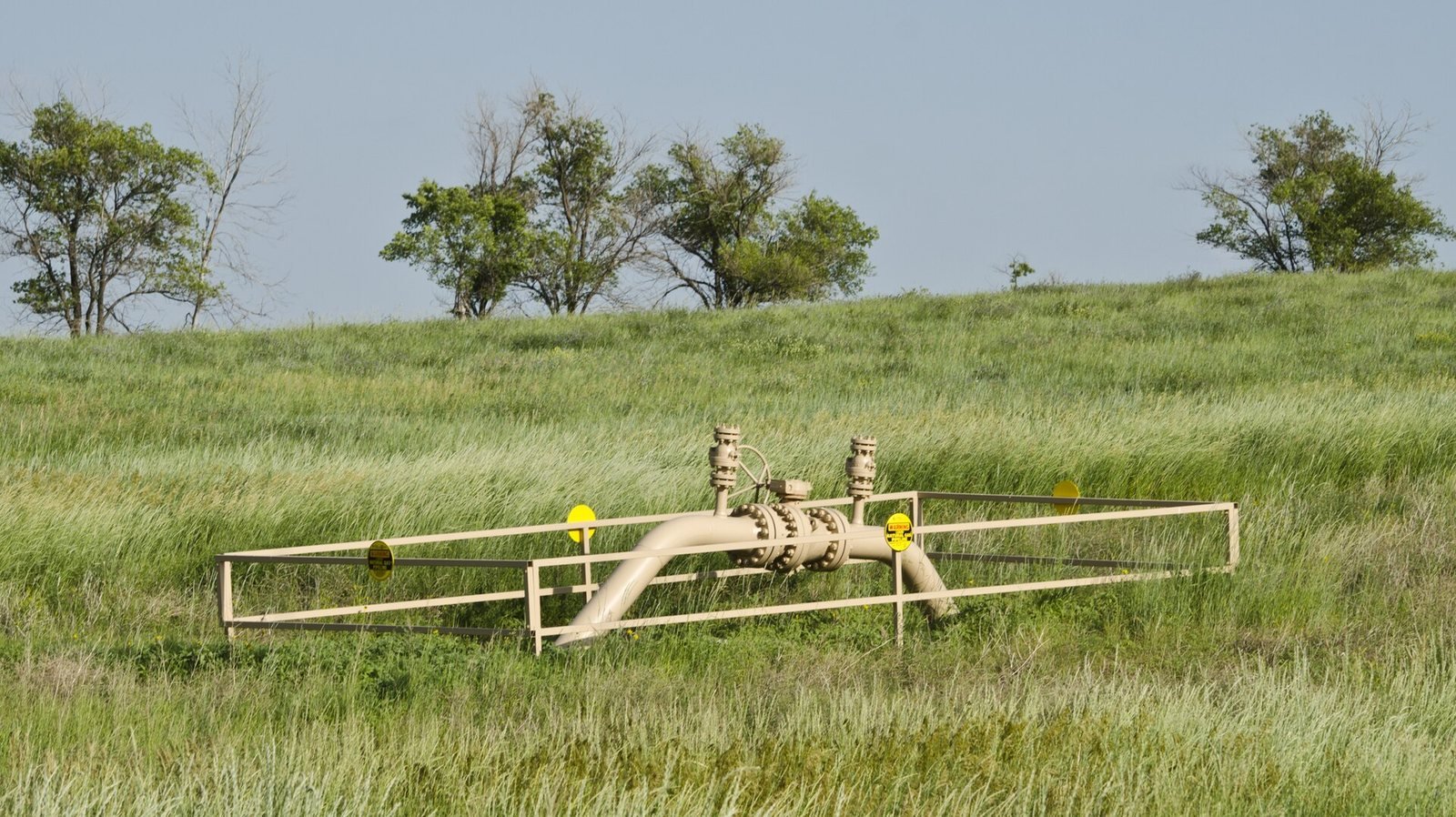
Featured image: natural gas pipeline valve in McKenzie County, North Dakota (not the WBI line at issue). Photo by Tim Evanson via Wikimedia Commons, CC BY-SA 2.0, resized.