Did the world’s top court really find Myanmar guilty of genocide? Yes. On November 19, 2026, the International Court of Justice (ICJ) ruled that Myanmar committed genocide against the Rohingya during the military’s 2017 “clearance operations” in northern Rakhine State. It is the first time the ICJ has ever found a state responsible for committing genocide. The court ordered Myanmar to investigate and prosecute those responsible, allow displaced Rohingya to return safely, and compensate the group, with the amount to be set later.
Below is a plain-English guide to what the court decided, how it reached that result, what it can and cannot make Myanmar do, and why lawyers are already reading the judgment for clues about other pending genocide cases.
What the ICJ decided in The Gambia v. Myanmar
The case is Application of the Convention on the Prevention and Punishment of the Crime of Genocide (The Gambia v. Myanmar: 11 States intervening). According to the court’s case page and its press release on the judgment, the ICJ found that Myanmar:
- committed genocide against the Rohingya group in northern Rakhine State (by nine votes to six);
- failed to prevent genocide by individuals acting alongside its security forces (nine to six);
- failed to punish genocide and related acts (11 to four);
- failed to enact the legislation the Genocide Convention requires (14 to one); and
- breached the court’s January 2020 provisional measures order by failing to preserve evidence (11 to four).
The court rejected one claim: by 14 votes to one, it found that Myanmar did not “directly and publicly” incite genocide by private persons. The vote counts above are as reported by the BBC and the International Crisis Group.
Reading the decision in The Hague, ICJ President Yuji Iwasawa said the court was “fully convinced that Myanmar committed acts falling under … the genocide convention with an intent to destroy a substantial part of the Rohingya population in Myanmar,” The Guardian reported.
How the case reached a final judgment
The Gambia filed the case on November 11, 2019. Myanmar argued The Gambia had no standing because it was not directly harmed. The court disagreed in a July 2022 ruling on preliminary objections, holding that any party to the Genocide Convention can bring a case because the duty to prevent and punish genocide is owed to all parties, a concept lawyers call an obligation erga omnes partes. If you want background on how the ICJ fits among other international courts, our explainer on how countries resolve global disputes under international law covers the basics.
Eleven states intervened to give their reading of the convention. Hearings on the merits, including witness testimony, were held from January 12 to 29, 2026, according to the court’s press release.
Why proving genocide is so hard, and what changed here
The intent requirement
Under Article II of the 1948 Genocide Convention, genocide means certain acts, such as killing members of a group, causing serious bodily or mental harm, or imposing measures intended to prevent births, committed “with intent to destroy, in whole or in part, a national, ethnical, racial or religious group, as such.” That specific intent is what separates genocide from war crimes and crimes against humanity.
When there is no direct proof of intent, the ICJ infers it from a pattern of conduct only if genocidal intent is “the only reasonable inference” from the evidence. That bar has been hard to clear. In 2007 the court found Serbia responsible for failing to prevent and punish the Srebrenica genocide, but not for committing it, and in 2015 it rejected genocide claims by both Croatia and Serbia against each other.
How the court applied the test to Myanmar
Myanmar argued the 2017 operations were counter-insurgency measures against the Arakan Rohingya Salvation Army (ARSA). According to the Crisis Group’s analysis of the judgment, the court made clear that the “only reasonable inference” test can be met even when genocidal intent coexists with other aims. It found the operations did not distinguish civilians from fighters, that state forces attacked Rohingya as they fled, and that the scale of violence went well beyond punishment or forced displacement. The court also treated the UN fact-finding mission’s reports as reliable and drew inferences more readily because Myanmar had blocked investigators and destroyed evidence.
The Guardian reported that the court also linked sexual violence and birth restrictions, including limits of two children per Rohingya family, to the convention’s “measures intended to prevent births.” The ruling also formally treats the Rohingya as a protected ethnic group, a status Myanmar has long denied.
What Myanmar has been ordered to do
The court ordered Myanmar to:
- enact legislation giving full effect to the Genocide Convention;
- take “immediate and effective steps” to investigate everyone reasonably suspected of genocidal acts and, if warranted, prosecute and punish them;
- give assurances and guarantees that the violations will not be repeated;
- adopt measures of restitution, including the safe, voluntary and dignified return of displaced Rohingya, whether they are inside Myanmar or abroad, and the reunification of families; and
- compensate the Rohingya group and its members.
The amount and form of compensation will be decided in a later phase. Myanmar must send the court a report within two years on the restitution measures it has taken and on the amount and modalities of compensation, according to the UN’s summary of the judgment. The Crisis Group notes the court declined The Gambia’s request to order full citizenship for the Rohingya, but required Myanmar to protect them from discrimination, including in access to citizenship and freedom of movement.
Can the ICJ enforce the ruling?
Not directly. ICJ judgments are final and binding, and there is no appeal. Under Article 94 of the UN Charter, every UN member agrees to comply with ICJ decisions in cases to which it is a party. If a state does not comply, the other party can go to the UN Security Council, which “may, if it deems necessary, make recommendations or decide upon measures to be taken to give effect to the judgment.”
In practice, the Crisis Group points out that the Security Council has never used that power to enforce an ICJ judgment, and that a Chinese or Russian veto would be likely here. This gap between binding law and real enforcement is a long-running problem; our piece on whether human rights laws are keeping up with modern challenges looks at the veto issue more broadly. Myanmar complied in form with the court’s 2020 provisional measures order, filing all 13 required reports, but the Crisis Group says conditions for the Rohingya changed little.
Early reactions
UN Secretary-General António Guterres called the judgment a “powerful recognition of the Rohingya victims of genocide,” UN News reported. The Guardian reported that the UK said it was expelling Myanmar’s defence attaché and called for a Security Council session, and that the U.S. State Department said it would study the decision “to fully assess its implications.”
What the ruling means beyond Myanmar
Individual accountability is a separate track
The ICJ judges states, not people, so no one will be arrested or sentenced because of this ruling. Individual cases run elsewhere. The International Criminal Court’s prosecutor requested an arrest warrant for Min Aung Hlaing, now Myanmar’s president, in November 2024 on crimes against humanity charges, and a federal court in Argentina issued warrants for 25 people in February 2025 under universal jurisdiction, according to the Crisis Group. Neither court is bound by the ICJ’s findings, but those findings are likely to be studied closely.
Other genocide cases at the ICJ
The judgment’s treatment of intent now forms part of the backdrop for other genocide cases pending at the ICJ, including South Africa v. Israel and Ukraine v. Russia. How much it shapes those cases will depend on their own evidence. For the refugee side of the story, more than a million Rohingya still live in camps in Bangladesh, a situation tied to the wider questions in our guide to immigration laws and their global impact.
FAQ
Is this the first time a country has been found guilty of genocide?
It is the first time the ICJ has found a state responsible for committing genocide. Other tribunals have convicted individuals of genocide, for example over Rwanda in 1994 and Cambodia under the Khmer Rouge, and the ICJ found Serbia responsible in 2007 only for failing to prevent and punish genocide.
Can Myanmar appeal the ICJ judgment?
No. ICJ judgments are final. A party can ask the court to interpret a judgment or, in narrow cases involving newly discovered facts, to revise it, but there is no appeal.
When will Rohingya victims be compensated?
Not soon. The court left the amount and method of compensation for a later phase and gave Myanmar two years to report on restitution and its proposed compensation.
Does the ruling mean Min Aung Hlaing will be arrested?
Not by itself. The ICJ does not prosecute individuals. Any arrest would come through the ICC or national courts, and depends on states cooperating.
This article is general information about an international court ruling, not legal advice.
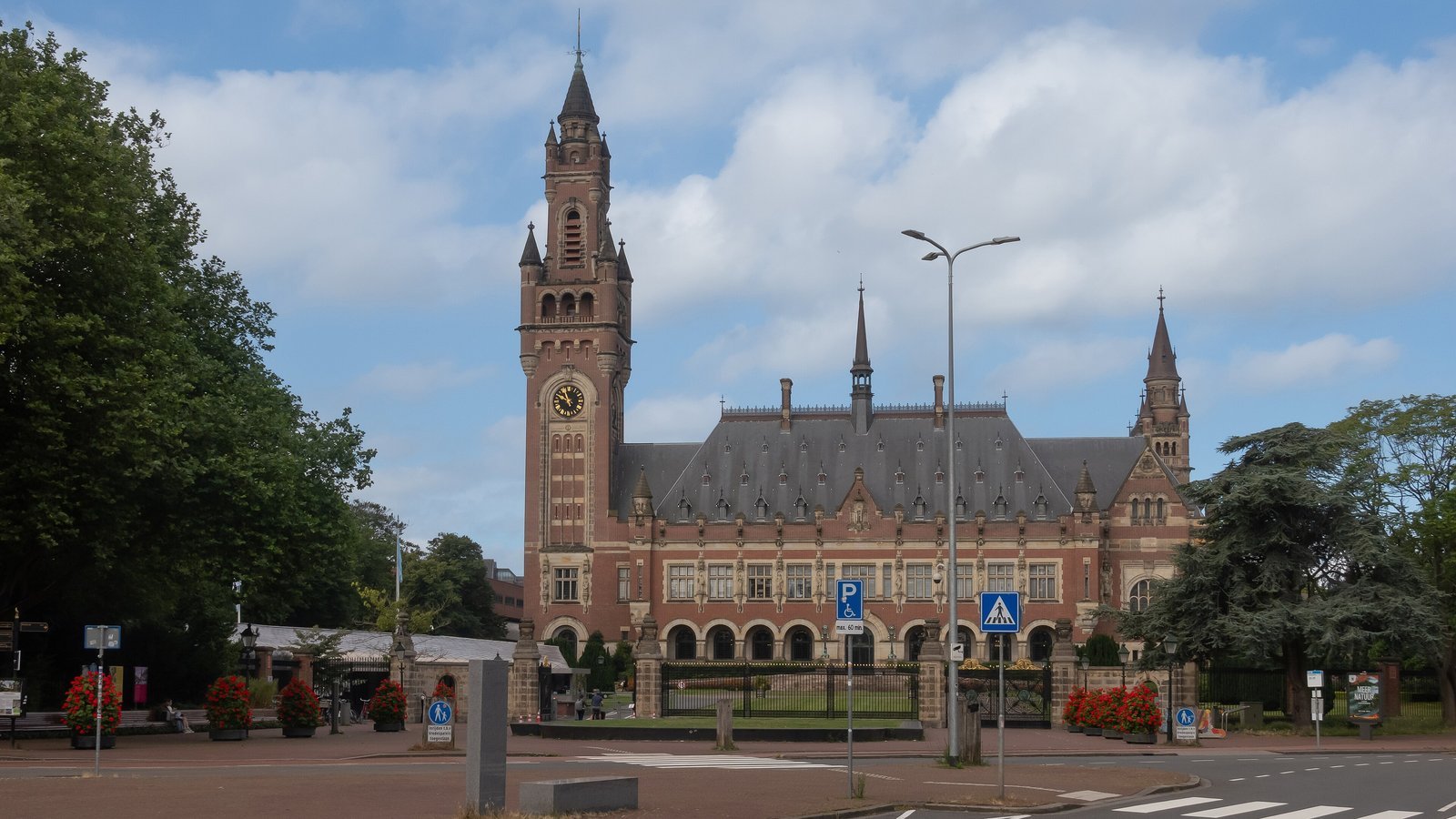
Featured image: The Peace Palace in The Hague, seat of the International Court of Justice. Photo by Michielverbeek via Wikimedia Commons, licensed CC BY 4.0, cropped.