Short answer: A federal judge has thrown out the Justice Department’s lawsuit against Montgomery County, Maryland’s gun law, but he did not decide whether the law is constitutional. On Monday, Nov. 9, 2026, U.S. District Judge Theodore D. Chuang ruled that the federal statute the department sued under, a police-misconduct law, simply doesn’t cover this kind of challenge. The case was dismissed with prejudice, so it can’t be refiled, though the department can still appeal. The county’s ban on carrying guns in and near “places of public assembly” stays on the books, and other lawsuits against it are still moving.
Here is what the court decided, why the Second Amendment question was never reached, and what could happen next.
What did the judge decide?
In a 33-page opinion, Judge Chuang granted the county’s motion to dismiss and denied the Justice Department’s request for a preliminary injunction that would have blocked enforcement, according to Bethesda Today and FOX 5 DC.
The key point is what the ruling did not do. As the Maryland Daily Record reports, the judge “did not reach whether the firearms ordinance violates the Second Amendment.” Instead, he found that the government had not alleged an unconstitutional “pattern or practice of conduct” by law enforcement officers, which is the core requirement of the statute it relied on.
“Notably, the Complaint is devoid of any allegations of actual conduct by law enforcement officers relating in any way” to the measure, Chuang wrote, as quoted by the Daily Record. He also noted that the government could not point to any case under that statute “in which the claim was not based on actual conduct by law enforcement officers depriving individuals of constitutional rights.”
Chuang framed the decision partly in terms of federal power. “Under our system of government, the federal government should not have unfettered authority to intrude on the actions of state and local governments,” he wrote, according to Bethesda Today. “Congress, not the Executive Branch, should decide when such intrusions are warranted by the need to protect individual rights.”
Why the Justice Department’s legal theory failed
The department filed suit on Aug. 3, 2026, against the county and two of its public safety agencies, calling the law “breathtaking in scope” and likely unconstitutional. It argued that a licensed carrier could not realistically travel through the county without entering a restricted zone, and that the ban applies even when a person holds a valid carry permit and the property owner allows the gun, as FOX 5 DC summarized.
To get into federal court, the department used 34 U.S.C. § 12601, a provision of the Violent Crime Control and Law Enforcement Act of 1994. That law makes it unlawful for a government authority to engage in a pattern or practice of conduct by law enforcement officers that deprives people of rights protected by the Constitution or federal law, and it lets the Attorney General sue for equitable and declaratory relief. It is the statute the department has long used for investigations of police departments, which is why the ruling turned on police conduct.
The department’s theory was that because county officers are responsible for enforcing the ordinance, adopting it and being ready to enforce it was enough. The judge disagreed. According to Bearing Arms, the complaint contained no allegations of unconstitutional arrests, citations or other enforcement actions under the ordinance, and no history of similar enforcement under earlier versions of the county’s restrictions. If you want the basics on what officers can and can’t do and how misconduct claims normally work, our explainer on police powers and their legal limits covers it.
What “dismissed with prejudice” means
A dismissal with prejudice is a final end to the case in the trial court: the same plaintiff can’t file the same claims again. It is not the end of the road, though. The department can ask the U.S. Court of Appeals for the Fourth Circuit to review the ruling. Justice Department spokesperson Kiersten Pels told Bethesda Today the department is “assessing the decision and next steps but remains committed to protecting the Second Amendment rights of law abiding citizens in Maryland.”
What does Montgomery County’s gun law do?
The law at issue is Expedited Bill 23-26. County Council records show it passed 10 to 1, was signed on July 21, 2026, and took effect on July 27, 2026. It prohibits firearms in and within 100 yards of “places of public assembly,” a category that, according to news reports, includes places such as parks, places of worship, schools, libraries, recreational facilities, courthouses and polling places. FOX 5 DC reports that the law includes exceptions for traveling along public highways within those 100-yard zones, and it has limited exemptions such as for law enforcement.
Why the county rewrote it this year
The bill was a response to a state court case. On April 28, 2026, the Supreme Court of Maryland decided Engage Armament LLC v. Montgomery County, a challenge to the county’s earlier firearm ordinances. The court held that state law (Criminal Law § 4-209(b)) expressly lets charter counties regulate firearms in or within 100 yards of a park, church, school, public building or other place of public assembly. It upheld the county’s rules for places like parks, places of worship, schools, libraries, courthouses, recreational facilities and polling places, but found the county went too far with some other locations and with permit holders carrying on public highways.
That state ruling was about how much power a Maryland county has under state law. It did not decide whether the restrictions satisfy the Second Amendment, which is the question still being fought in federal court.
Other lawsuits are still pending
The Justice Department’s case was only one of several. In September, Senior U.S. District Judge Deborah K. Chasanow declined to block the ordinance in a facial challenge brought by Maryland Shall Issue and several gun owners, finding they were unlikely to succeed. In a separate case, she found that the Silver Spring Jewish Center was likely to succeed as the law applied to its house of worship, and issued a preliminary injunction limited to the synagogue and Rabbi J. Menashe Shapiro, the Daily Record reports. Both sets of plaintiffs have appealed to the Fourth Circuit.
Those appeals are where the constitutional question is most likely to be answered. Under the Supreme Court’s 2022 decision in New York State Rifle & Pistol Association v. Bruen, a gun regulation must be consistent with the nation’s historical tradition of firearm regulation. Bruen recognized that some “sensitive places,” such as schools, government buildings, legislative assemblies, polling places and courthouses, can have gun restrictions, but it left open how far that idea stretches. Whether a 100-yard buffer around parks and places of worship fits is the kind of issue the Fourth Circuit may have to decide. For background on how this debate has developed, see our overview of the gun control debate in 2025.
What this means for people in Montgomery County
For now, the ruling leaves the county’s law in place, apart from the court order limiting enforcement as to the Silver Spring synagogue and its rabbi. A spokesperson for the county State’s Attorney’s Office previously told Bethesda Today that the office did not intend to prosecute gun violations under the legislation while constitutional challenges were pending. That is a statement of prosecutorial intent, not a change in the law, and it could change. Anyone unsure how the rules apply to them should check the county’s official guidance or speak with a Maryland-licensed attorney.
The bigger takeaway is about federal power. The ruling suggests the Justice Department can’t use the police-misconduct statute to challenge a local gun law before any enforcement has happened. It fits a broader pattern of courts policing the limits of who can sue whom, which also came up in the Supreme Court’s recent Bivens case on suing federal officers.
FAQ
Did the judge rule that Montgomery County’s gun law is constitutional?
No. Judge Chuang decided only that the Justice Department could not bring this lawsuit under 34 U.S.C. § 12601. His opinion does not analyze whether the law is consistent with the Second Amendment.
Can the Justice Department appeal?
Yes. The case was dismissed with prejudice, so it can’t be refiled in the district court, but the department can appeal to the Fourth Circuit. As of Nov. 9, it said it was assessing next steps.
Where does the law ban guns?
In and within 100 yards of “places of public assembly,” which according to news reports include parks, places of worship, schools and libraries, among others, with exceptions such as travel on public highways. Check the county’s official text for the full list.
Are other challenges still alive?
Yes. Appeals from Maryland Shall Issue and other gun owners, and from the Silver Spring Jewish Center, are pending at the Fourth Circuit.
This article is for general information only and is not legal advice. Court rulings and enforcement policies can change quickly; check official sources or consult a licensed attorney about your situation.
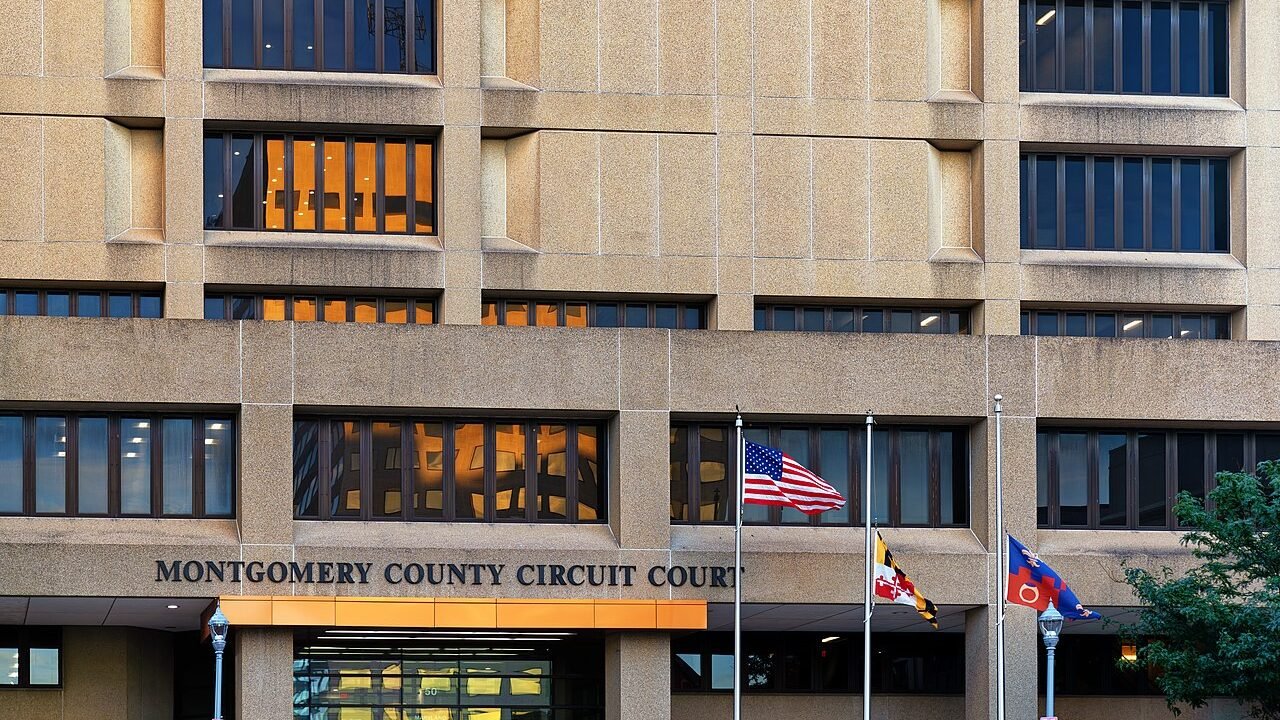
Featured image: Montgomery County Circuit Court in Rockville, Maryland. Photo by Tony Webster via Wikimedia Commons, licensed CC BY 2.0, cropped.