Short answer: Right now, you can sue an individual federal officer for money damages over a constitutional violation only in a very narrow set of situations, under a 1971 Supreme Court decision known as Bivens. On Monday, Nov. 9, 2026, the Supreme Court is scheduled to hear Nielsen v. Watanabe, a federal prisoner’s medical-care case that could shrink that path even further or, if the justices go as far as one side asks, close it entirely.
Here is what the case is about, what each side is arguing, and what the possible outcomes could mean for people who say a federal employee violated their rights.
What is Nielsen v. Watanabe about?
The plaintiff, Kekai Watanabe, was injured in a gang-related fight in 2021 while held at a federal detention center in Honolulu, according to SCOTUSblog’s case preview. He says he told the paramedic who treated him, Francis Nielsen, that his pain was a 10 out of 10, but was given only over-the-counter pain medication. He alleges he spent more than two months in solitary confinement without seeing a specialist or going to a hospital. An X-ray taken about seven months later showed a fractured tailbone, with bone chips that had moved into the surrounding soft tissue.
In February 2022, Watanabe sued Nielsen in federal court in Hawaii, claiming deliberate indifference to his serious medical needs in violation of the Eighth Amendment’s ban on cruel and unusual punishment. USA Today reports that he is seeking $3 million. These are his allegations, and no court has decided whether they are true. The question before the Supreme Court is whether he is allowed to bring this kind of damages claim at all.
The district court dismissed the case. The U.S. Court of Appeals for the 9th Circuit reversed, finding that Watanabe’s claim was “identical to Carlson in all meaningful respects,” and a divided 9th Circuit declined to rehear it. The Supreme Court agreed in June to take the case. The official question, as listed on the case page, is whether the 9th Circuit “erred here in recognizing a Bivens cause of action.”
What is a Bivens claim?
When a state or local officer, such as a city police officer, violates someone’s constitutional rights, Congress has provided a way to sue for damages through the federal civil rights statute, 42 U.S.C. § 1983. There is no matching general statute for federal officers.
In 1971, in Bivens v. Six Unknown Named Agents of Federal Bureau of Narcotics, the Supreme Court filled part of that gap. It ruled that a violation of a person’s constitutional rights by a federal official could support a claim for money damages. The court later recognized similar claims only twice:
- Davis v. Passman (1979): a former congressional staffer could sue a member of Congress for alleged sex discrimination under the Fifth Amendment.
- Carlson v. Green (1980): the estate of a federal prisoner who died after an asthma attack could sue prison officials who allegedly failed to give him proper medical care.
Since then, the court has repeatedly refused to extend Bivens. In Egbert v. Boule (2022), it noted it had “declined 11 times” to recognize similar claims and said that “in all but the most unusual circumstances, prescribing a cause of action is a job for Congress, not the courts.” For more on how constitutional limits on law enforcement work in general, see our guide to police powers and their legal limits.
The two-step test courts use today
Under the court’s recent cases, a judge first asks whether a claim arises in a “new context,” meaning it differs in a meaningful way from Bivens, Davis or Carlson. If it does, the judge then asks whether there are “special factors” suggesting Congress is better placed than the courts to decide whether a damages remedy should exist. If there is even one such reason, the claim cannot go forward.
What each side is arguing
Nielsen: this is a new context, and Bivens should go
Nielsen argues Watanabe’s case is “meaningfully—profoundly—different” from Carlson. The prisoner in Carlson died within hours, so money damages for his estate were the only possible remedy. Watanabe survived, and Nielsen says he could have sought more treatment through the Bureau of Prisons’ internal grievance system (the Administrative Remedy Program) or through a court order. Nielsen also points to the Prison Litigation Reform Act of 1996, which requires prisoners to use internal appeals before suing, as a sign that Congress did not want a damages remedy here.
Nielsen then goes further. In his briefs, he asks the court to overrule Bivens, Davis and Carlson altogether, calling them “relics of the bygone days when federal courts thought it appropriate to create causes of action Congress had not authorized.”
The federal government: end Carlson claims, but not Bivens here
The Trump administration filed a brief supporting Nielsen. Solicitor General D. John Sauer told the court that “Carlson has become entirely obsolete” in light of the prison grievance program and newer laws. But the government urged the justices not to overrule Bivens in this case, saying that if the court wants to take up that question, it should do so in a Fourth Amendment case that looks more like Bivens itself.
Watanabe: this is a textbook Carlson case
Watanabe argues his claim is the same as Carlson: a federal prisoner, a federal prison officer, the Eighth Amendment and the same deliberate-indifference standard. In his brief to the court, he notes that the justices have refused to extend Bivens but have also “repeatedly declined calls to overturn the doctrine entirely.” He says that only money can make up for pain he already suffered.
He also argues that Congress has accepted Carlson claims. He points to the Westfall Act of 1988, which carved out an exception for federal constitutional claims, and to the Prison Litigation Reform Act, which regulates these suits rather than abolishing them.
Possible outcomes
As another SCOTUSblog analysis lays out, the court has several options:
- Affirm the 9th Circuit and let Watanabe’s claim proceed under Carlson.
- Distinguish Carlson, ruling that differences such as the survival of the prisoner make this a new context. That could limit Carlson-type claims to cases involving deaths.
- Overrule Carlson but leave Bivens in place.
- Overrule Bivens entirely, a step several conservative justices have suggested in the past.
A decision is expected in 2027, likely by the end of the term in late June or early July.
Why this case is getting so much attention
Although the facts involve one prisoner’s medical care, the ruling could affect anyone who says a federal officer violated their constitutional rights, including in immigration enforcement. USA Today quoted Erwin Chemerinsky, dean of the UC Berkeley School of Law: “If Bivens is eliminated, then there’ll be literally no way to sue in federal court when a federal agent like ICE violates the Constitution.”
Critics of Bivens see it differently. In their view, the 1971 court created a right to sue that Congress never passed, and the choice belongs to lawmakers. If the court closes the door, Congress could still pass a law creating a damages remedy against federal officers. Other routes, such as the Federal Tort Claims Act, which allows certain claims against the United States itself, would remain, but they work differently and come with their own limits and exceptions. Our overview of the basic legal rights every citizen should know covers more of that background.
The case is being argued the same morning as another closely watched dispute, Hoffmann v. WBI, the pipeline eminent domain case over landowners’ legal fees, according to the court’s November hearing list.
FAQ
Can I sue a federal agent today?
Only in narrow circumstances. Courts allow Bivens damages claims only when the facts closely match Bivens, Davis or Carlson, and they reject nearly every claim that differs in a meaningful way. Other options, such as claims against the United States under the Federal Tort Claims Act, have their own rules and deadlines.
Does this case decide whether Watanabe was mistreated?
No. The Supreme Court is deciding only whether this type of lawsuit can go forward. His allegations have not been proven.
Does Section 1983 apply to federal officers?
Generally, no. Section 1983 covers people acting under state law, such as state and local police. That is why Bivens matters for claims against federal officers.
When will the Supreme Court rule?
A decision is expected sometime in 2027, most likely before the term ends in summer.
This article is for general information only and is not legal advice. If you believe your rights were violated, talk to a licensed attorney in your jurisdiction about your specific situation and any deadlines that may apply.
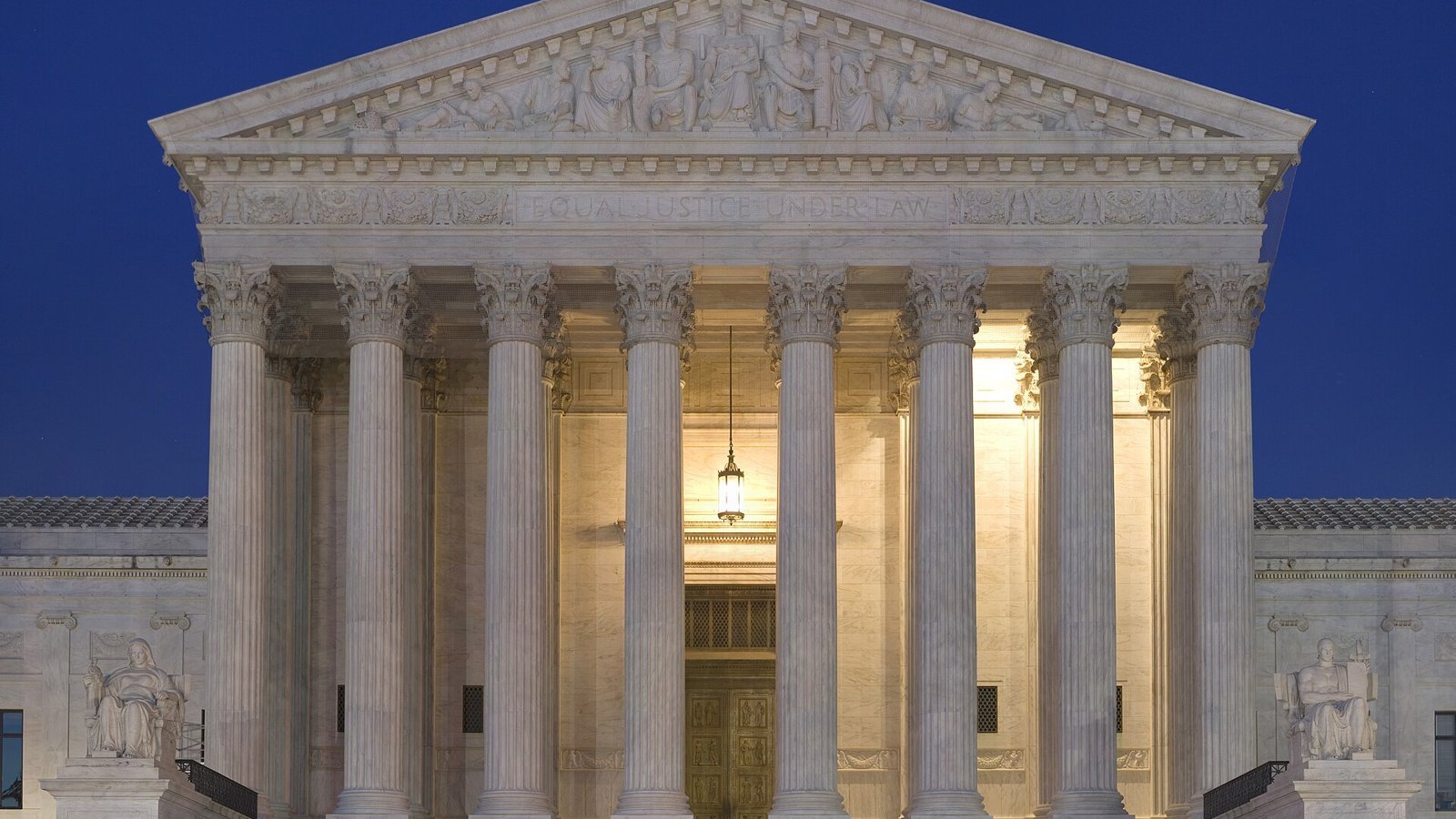
Featured image: the U.S. Supreme Court building at dusk. Photo by Noclip via Wikimedia Commons, public domain, cropped.