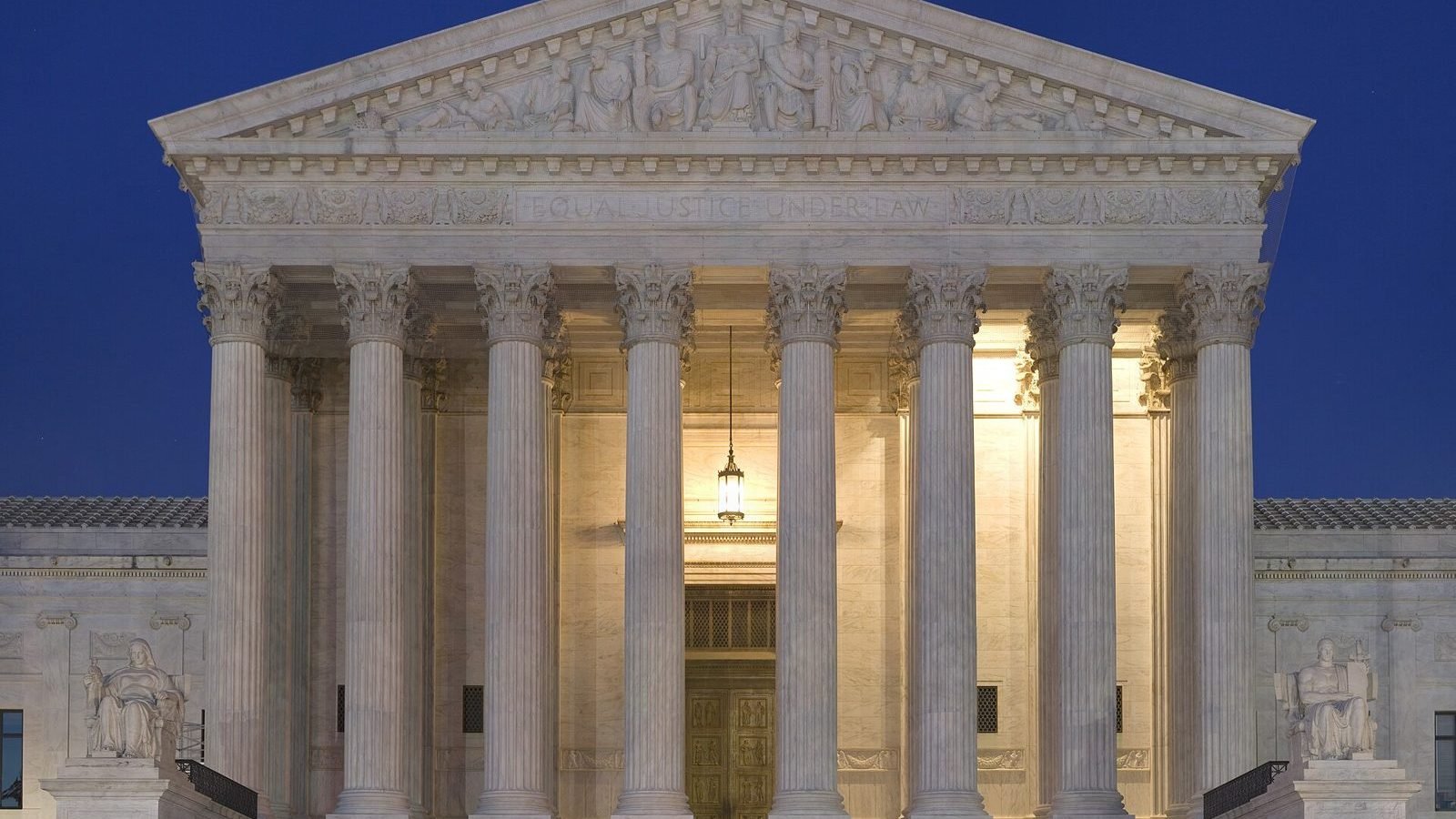
Can a federal agency act as prosecutor and judge, then order a business to pay hundreds of thousands of dollars without a real federal court ever hearing the case? That is the question the U.S. Supreme Court took up on Nov. 10, 2026, in Department of Labor v. Sun Valley Orchards, LLC. The short answer for now: nobody knows yet, but the argument suggested several justices are open to limiting how agencies impose fines in their own in-house tribunals. A ruling is expected by the end of the term, and it could reach well beyond one New Jersey farm.
What is Department of Labor v. Sun Valley Orchards about?
Sun Valley Orchards is a family farm in New Jersey that grows fruits and vegetables, including asparagus, zucchini, peppers and peaches. According to the Third Circuit’s opinion, it first used the H-2A temporary agricultural visa program in 2015, hiring 96 foreign workers and 51 domestic workers in “corresponding employment.”
Under H-2A, an employer can bring in seasonal foreign farmworkers only after it gets a labor certification from the Department of Labor (DOL) and promises certain terms in a “job order.” Those terms include no-cost housing, access to a kitchen or meal plan, and safe transportation to the work site. Federal law, 8 U.S.C. § 1188(g)(2), lets the Secretary of Labor take action, “including imposing appropriate penalties,” to make sure employers keep those promises.
What DOL said the farm did wrong
DOL investigators said the farm broke its job order in several ways. The Third Circuit opinion lists housing problems such as missing window screens, sinks without hot water and mattresses on the floor; workers charged for meals and drinks instead of getting promised kitchen access; transport vans with worn tires and drivers without valid licenses; and workers pushed to leave before the contract ended, in breach of the rule that guarantees at least three-quarters of the promised hours.
The farm contested the findings before a DOL administrative law judge (ALJ), who largely agreed with the agency and set the totals at $211,800 in civil penalties and $344,945.80 in back wages. DOL’s Administrative Review Board affirmed. No jury and no life-tenured federal judge decided those facts.
How the case reached the Supreme Court
Represented by the Institute for Justice, Sun Valley sued in federal court in 2021, arguing that only an Article III court can decide this kind of claim. A federal district court in New Jersey disagreed in 2023.
Then the Supreme Court decided SEC v. Jarkesy in 2024. In that case, the Court held that when the Securities and Exchange Commission seeks civil penalties for conduct that looks like common-law fraud, the defendant is entitled to a jury trial in court, not an in-house hearing. Relying on Jarkesy, a unanimous Third Circuit panel ruled for Sun Valley on July 29, 2025. Judge Thomas Hardiman wrote that DOL’s claim looked like a breach-of-contract action, a classic “private right,” and that “Article III required the Department of Labor to instead proceed before a federal district court.”
The government appealed. On April 27, 2026, the Supreme Court agreed to hear the case (No. 25-966) on two questions: whether Article III bars DOL from adjudicating these monetary claims, and whether § 1188(g)(2) even authorizes DOL to do so in-house.
The legal fight: “public rights” vs. “private rights”
The Constitution gives the “judicial Power” to federal courts, whose judges have life tenure and salary protection. But for a long time the Supreme Court has allowed agencies to decide some disputes involving “public rights,” matters that historically could be handled by the executive branch or Congress without a court.
Under Jarkesy, if a federal claim resembles a traditional lawsuit at common law, it is presumed to be a private right that belongs in court, unless it fits a recognized public-rights category. Customs, taxes, immigration and government benefits are classic examples.
- The government’s view: Principal Deputy Solicitor General Sarah Harris argued that two public-rights categories overlap here: the government’s control over immigration and its power to grant privileges. The employer only gets foreign workers because it agreed to the government’s conditions, so the government can enforce those conditions itself. She leaned heavily on Oceanic Steam Navigation Co. v. Stranahan (1909), which upheld fines imposed by executive officials on shipping companies that brought in passengers barred from entry.
- The farm’s view: Robert E. Johnson of the Institute for Justice argued that the immigration tradition covers who may cross the border, not labor disputes on a farm with both foreign and domestic workers. In his words at argument, this is “a far cry from a case about labor issues at a farm in New Jersey with a mix of foreign and domestic workers.”
What the justices said at oral argument
According to the official transcript and coverage by SCOTUSblog and NPR, the bench appeared divided.
Justices skeptical of the government
Chief Justice John Roberts said the conditions in this case “look more like a condition of employment rather than … entry,” and suggested the government was trying to stretch its broad power over admission to cover workplace issues months later. Justice Amy Coney Barrett agreed that removal of noncitizens can be handled without an Article III court but wondered whether fines are different. Justice Brett Kavanaugh pointed to Tull v. United States (1987), where the Court described a civil penalty as a remedy that could only be enforced in courts of law. Justice Neil Gorsuch also questioned the government’s position.
Justices more sympathetic to DOL
Justice Elena Kagan pushed back hard on the farm’s lawyer, describing H-2A as an immigration program: employers make promises so the government will let in foreign workers, and breaking those promises is breaking a condition of admission. Justice Ketanji Brown Jackson pressed Johnson to square his position with past decisions approving administrative civil penalties. Kavanaugh also challenged the farm’s proposed line, saying that “if we’re looking for clarity, what you’re proposing there is really at war with clarity.”
The government’s warning
Harris told the Court that a broad ruling would disrupt penalty systems across government, from Medicare and Medicaid to government contracts and student loans. “If the Court were to say civil penalties always have to be in Article III courts, that’s kind of the nuclear option,” she said.
Why this case matters beyond one farm
Many federal agencies impose civil penalties through ALJs and internal review boards. Since Jarkesy, agencies have argued that their programs fit within exceptions to that ruling. A broad win for Sun Valley could push more enforcement into federal district courts, which are slower and more costly for both sides, and could give businesses a stronger right to a jury. A narrow ruling might confine the outcome to H-2A back-pay and penalty claims, or turn on the statutory question of what Congress actually authorized.
For farmworkers, the stakes are practical too. DOL enforcement is a main way H-2A workers recover unpaid wages, and back pay in this case was meant to go to workers. If DOL has to sue in court, enforcement may become slower or less frequent, as the government warned. The farm and its supporters argue that a neutral judge, and potentially a jury, is the safeguard the Constitution requires before anyone’s money is taken.
The case also fits a broader trend. In recent years the Court has narrowed agency power in decisions such as Loper Bright Enterprises v. Raimondo, which ended Chevron deference, and Jarkesy itself. Earlier this month, the justices also heard Nielsen v. Watanabe, a case about whether people can still sue federal officers, another dispute over how far government power reaches and who gets a day in court. For background on how the Court’s recent rulings fit together, see our overview of the Supreme Court’s 2025 landmark decisions.
What happens next
The justices will deliberate privately, and a written opinion is expected by the end of the term, usually late June or early July 2027. SCOTUSblog’s Ronald Mann predicted the case could “come down late and be sharply divided.” Possible outcomes include:
- Reversing the Third Circuit and holding that H-2A enforcement fits the immigration or public-privilege exception, so DOL keeps its in-house process.
- Affirming and holding that DOL must bring claims for penalties and back wages in federal court.
- Deciding on narrower grounds, such as the statutory question about § 1188(g)(2), without a sweeping constitutional rule.
Until then, the Third Circuit’s ruling stands in that circuit (Delaware, New Jersey, Pennsylvania and the U.S. Virgin Islands). Employers who use temporary visa programs, and workers who rely on DOL to enforce their contracts, should watch the outcome closely. For more on how U.S. policy shapes visa and work programs, read our explainer on changing immigration laws and their global impact.
FAQ
What is the H-2A visa program?
H-2A lets U.S. agricultural employers hire foreign workers for temporary or seasonal farm work when not enough U.S. workers are available. Employers must offer set wages and benefits, including housing and transportation, and the Department of Labor enforces those terms.
What did SEC v. Jarkesy decide?
In 2024 the Supreme Court held that the SEC could not use an in-house proceeding to impose civil penalties for securities fraud. The defendant was entitled to a jury trial because the claim resembled common-law fraud.
Has the Supreme Court decided Sun Valley Orchards yet?
No. The case was argued on Nov. 10, 2026. A decision is expected by the end of the Court’s term in mid-2027.
This article is general information about a pending court case, not legal advice. If you are an employer or worker with a specific dispute, talk to a licensed attorney in your state.
Sources: Third Circuit opinion in Sun Valley Orchards, LLC v. U.S. Department of Labor, No. 23-2608 (July 29, 2025); Supreme Court docket No. 25-966 and the Nov. 10, 2026 oral argument transcript; SCOTUSblog; NPR; Institute for Justice; 8 U.S.C. § 1188.