Can the Pentagon discharge the transgender service members who sued over President Trump’s military ban? Not for now. On November 17, 2026, the U.S. Court of Appeals for the D.C. Circuit refused to put its June ruling on hold while the administration asks the Supreme Court to step in, and it ordered the ruling to take effect immediately. That puts back in force a court order barring the military from expelling 27 currently serving plaintiffs in Talbott v. United States.
The order is narrow. It does not strike down the policy nationwide, and it does not let transgender people enlist. Here is what the court decided, who is covered, and what happens next, including a Supreme Court conference on December 4.
What the D.C. Circuit decided on November 17
The order itself is short. The panel of Circuit Judges Robert Wilkins and Justin Walker and Senior Circuit Judge Judith Rogers denied the government’s “motion to stay issuance of the mandate pending the filing and disposition of a petition for a writ of certiorari” and told the clerk to “issue the mandate forthwith.” The mandate is the formal step that makes an appeals court’s decision take effect. Until it issues, the decision is on paper only.
The vote was 2-1. Judge Walker noted that he would have granted the government’s motion. Judge Rogers joined Judge Wilkins in denying it, according to GLAD Law, which represents the plaintiffs with the National Center for LGBTQ Rights and several law firms.
Why the court said no to a delay
Under Federal Rule of Appellate Procedure 41(d), a party asking an appeals court to hold its mandate while it seeks Supreme Court review must show that its petition presents “a substantial question” and that there is “good cause for a stay.” In a statement attached to the order, Judge Wilkins wrote that good cause requires showing irreparable harm, and that the government had not done so.
He pointed out that the government had not alleged any irreparable harm from keeping the serving plaintiffs, whom he described as “decorated servicemembers” who have “served honorably” while meeting “all military standards.” He wrote that the Defense Department “has never specified—before the District Court, on appeal, or now in its motion to stay—what national security ‘risks’ will follow from retaining the serving Plaintiffs.” He also rejected the idea that any injunction against the executive branch automatically causes irreparable harm, saying “it cannot be that a mere assertion of executive prerogative suffices.”
The tension between security claims and individual rights is a long-running theme in American law, one we cover in our explainer on the balance between national security and civil liberties.
Who is covered, and who is not
The Talbott case was the first lawsuit filed against Executive Order 14183, signed in January 2025, and the Defense Department policy that followed it, which the courts call the “Hegseth Policy.” U.S. District Judge Ana Reyes in Washington blocked the policy in March 2025. The D.C. Circuit then paused her order while it heard the appeal.
On June 1, 2026, the panel issued a split decision, reported as Talbott v. United States, 176 F.4th 720. As Judge Wilkins summarized it this week, the panel “held that this Policy likely violates equal protection because it is not rationally related to any legitimate government interest.” But the panel split on the remedy:
- Currently serving plaintiffs: Judges Wilkins and Rogers affirmed the injunction blocking their expulsion. That is the part that took effect on November 17.
- Plaintiffs seeking to enlist: Judges Wilkins and Walker vacated the injunction as to them, so the policy’s accession (entry) standards are not blocked by this case.
GLAD Law says the order covers 27 service members who together have served more than 130 years and earned more than 80 commendations, and that they had been placed on administrative leave, with several scheduled for separation boards. The Advocate reported the same figures. Transgender service members who are not plaintiffs in Talbott are not directly protected by this order.
How this fits with the Supreme Court’s 2025 stay
This is not the first time the ban has been in court. In a separate case, United States v. Shilling, the Supreme Court in 2025 stayed a different judge’s injunction against the policy, which let the ban take effect. Judge Wilkins wrote that Shilling “does not disturb” the panel’s view because that case “involved a universal injunction that barred enforcement of the Hegseth Policy on retention and accession,” while the Talbott order “has been narrowed to cover only a limited group of currently serving Plaintiffs.”
What the government argues
The administration’s position is laid out in its petition for certiorari, filed August 27, 2026. The government describes the policy as one that “generally disqualifies from military service individuals who have gender dysphoria, a history of the condition, or a history of related interventions,” and says it was adopted because the Secretary determined that the related medical and mental health constraints “are incompatible with the high mental and physical standards necessary for military service.” Solicitor General D. John Sauer called the D.C. Circuit’s holding “gravely erroneous” and argued it “cannot be squared with this Court’s precedents or deference to the military.”
The government also argued that the Supreme Court’s 2026 decision in West Virginia v. B.P.J., which held that schools may restrict eligibility for girls’ and women’s sports based on biological sex, “casts doubt” on the panel’s analysis. Judge Wilkins disagreed. He wrote that B.P.J. addressed a sex-based classification the challengers conceded was generally valid, while Talbott asks whether the Hegseth Policy’s classifications are valid in the first place. He noted that the government had conceded the policy’s bar on waivers for anyone who “attempted to” transition covers social transition, which he said shows it classifies based on gender identity rather than a medical condition.
What happens next
Two tracks are moving at once.
The Supreme Court petition
The case is United States v. Talbott, No. 26-272. The plaintiffs filed their brief in opposition on November 2, the government replied on November 16, and on November 17 the petition was distributed for the justices’ December 4, 2026 conference. The justices could grant review, deny it, or hold the petition. Four votes are needed to take a case. If review is denied, the June ruling stands, much like the outcome we described in the Maryland sensitive places gun case. The government could also ask the justices directly for a stay.
The trial in district court
The case is also still going forward before Judge Reyes. GLAD Law says a trial is scheduled to begin in January 2027, and The Advocate reported a January 4 start date. The Advocate also reported that the Justice Department, in its Supreme Court reply, argued that taking the case now would signal the district court to halt “a trial that should not be happening in the first place.” A final ruling after trial could reach further than the current preliminary injunction, and it could be appealed too. For a primer on how courts check the other branches in disputes like this one, see our guide to the role of the judiciary in democratic systems.
FAQ
Is the transgender military ban still in effect?
Yes, in general. The November 17 order protects only the currently serving plaintiffs in Talbott from discharge. The Supreme Court’s 2025 stay in Shilling allowed the policy to be enforced, and this order does not change that for anyone else.
Can transgender people enlist now?
Not because of this case. The D.C. Circuit vacated the part of the injunction covering plaintiffs who sought to join the military.
When will the Supreme Court decide whether to hear the case?
The petition is set for the December 4, 2026 conference. Orders from that conference could come the following week, though the justices sometimes reconsider a petition at later conferences before acting.
This article is general information about a pending court case, not legal advice. Service members with questions about their own status should talk to a military legal assistance office or a licensed attorney.
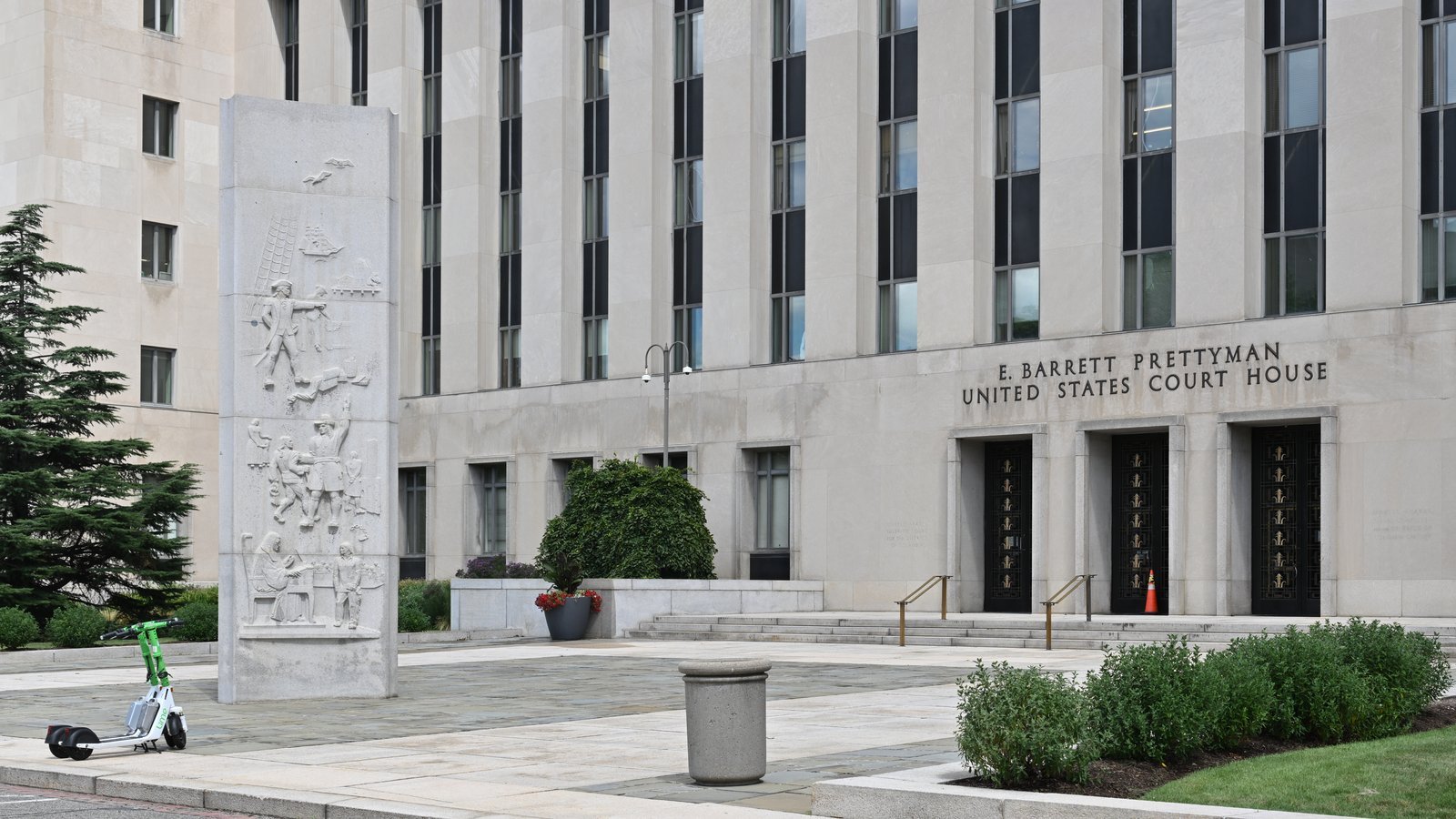
Featured image: E. Barrett Prettyman United States Court House in Washington, D.C., home of the U.S. Court of Appeals for the D.C. Circuit. Photo by G. Edward Johnson via Wikimedia Commons, licensed CC BY 4.0, cropped.