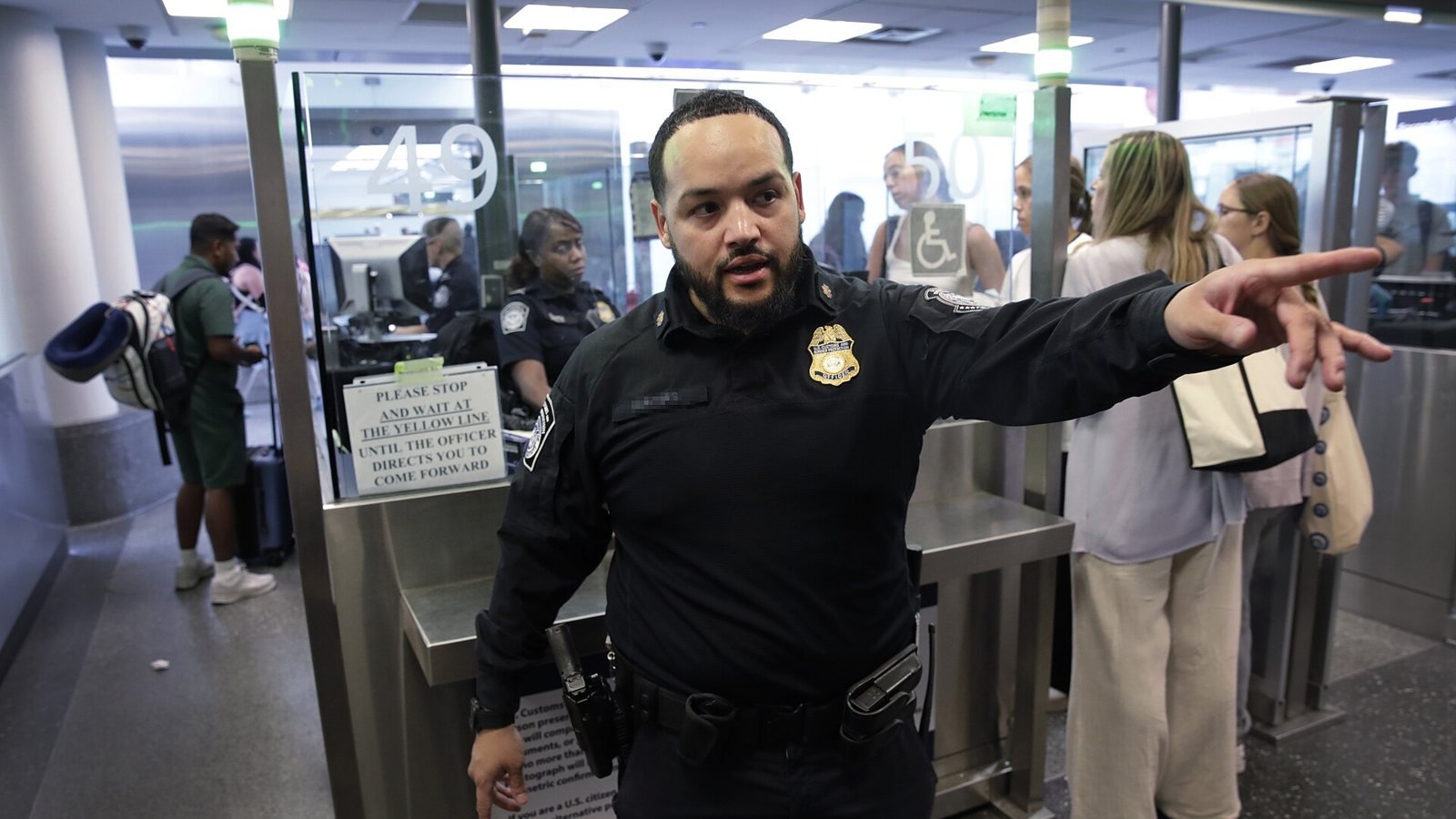
Can border agents search your phone without a warrant? In most of the United States, yes: Customs and Border Protection (CBP) says it can inspect phones, laptops and other devices at ports of entry, and courts have largely agreed. But a federal judge in Boston has just drawn a line. On November 13, 2026, U.S. District Judge Allison D. Burroughs blocked the Department of Homeland Security from reading data copied from immigration lawyer Andrew Lattarulo’s phone at Logan Airport, finding he is likely to prove the seizure was retaliation for his public criticism of immigration enforcement.
Here is what happened, what the ruling does and does not decide, and what the law says about phone searches when you fly back into the country.
What happened at Logan Airport
According to the judge’s memorandum and order in Lattarulo v. Mullin (No. 25-cv-12861), Lattarulo is an immigration lawyer and part owner of the Boston firm Georges Cote LLP. He also runs a popular Instagram account where he posts know-your-rights videos about immigration. Reason reports the account has more than 57,000 followers.
In September 2025, Homeland Security Investigations (HSI) was investigating the firm over whether it employed people without work authorization. The firm’s I-9 compliance officer, Audai Cote, received a Notice of Inspection on September 8 and a Notice of Suspect Documents on September 25, which gave the firm ten days to respond.
Lattarulo and Cote then took a weekend trip to Aruba. Cote flew back on September 27 without any problem. When Lattarulo landed at Logan the next day, three CBP officers and one HSI officer stopped him as he got off the plane. The court’s order says they seized his phone without a warrant and downloaded a complete copy of its data. The phone came back eight days later by overnight delivery, but the government kept the copy, which includes privileged attorney-client communications. The data is currently in an unreadable format, and the government told the court it intends to convert and search it if allowed.
What the judge decided
Judge Burroughs granted a preliminary injunction. In plain terms, DHS must keep the copied data in its current unreadable, unreviewable form until the lawsuit ends. The court did not order the data destroyed, citing the early stage of the case.
Why the First Amendment claim won for now
The ruling rests on First Amendment retaliation: the government cannot punish someone for protected speech. The judge found Lattarulo likely to show he “would not have been searched except for his protected speech.” She pointed to several facts in the record:
- Cote, who had the same or greater access to the firm’s employment records but did not speak publicly about immigrant rights, was not stopped.
- The government offered no evidence that phone searches are common in this kind of employment investigation.
- The seizure came only three days after the firm got its ten-day Notice of Suspect Documents.
The court wrote that the government’s choice of “a highly unusual investigative method that appears designed to inflict a maximal burden on Lattarulo lends substantial support to an inference that its actions were pretextual.” The government argued the stop was tied to the HSI investigation, but the judge found that explanation unconvincing on the limited record.
The Fourth Amendment question it left open
Because the speech claim was enough, the judge did not rule on whether the search violated the Fourth Amendment. She did flag the issue. Under the First Circuit’s 2021 decision in Alasaad v. Mayorkas, officers may do “routine” device searches at the border without suspicion and “non-routine” (forensic) searches without a warrant if they have reasonable suspicion. The open question is reasonable suspicion of what.
Here the suspected violation was unauthorized employment under 8 U.S.C. § 1324a, a law ICE enforces but which arguably is not a border-related crime. The judge wrote that “it appears that the government seized on a fortuitous border crossing following a weekend vacation as an opportunity to search for evidence of a domestic crime it was already investigating,” and said she was “not convinced” the border search exception was meant to reach that. She expressly declined to reach a firm conclusion yet.
Can CBP search your phone at the border? What the rules say
The ruling is narrow, so the general rules have not changed. CBP’s official page on border searches of electronic devices lays out its policy under CBP Directive 3340-049B:
- Basic search: an officer looks through the device by hand. CBP policy requires no suspicion.
- Advanced search: an officer connects equipment to copy or analyze the contents. CBP policy requires reasonable suspicion of a violation of a law CBP enforces, or a national security concern, plus a senior manager’s approval.
- No cloud: officers are supposed to disable network connections and search only what is stored on the device itself.
- Passwords: travelers must present devices in a condition that allows inspection. A locked device may be detained. CBP says a U.S. citizen will not be denied entry for refusing, but the device may be held. Foreign visitors’ refusal can factor into admissibility decisions.
- Retention: CBP may keep copies when there is probable cause of a violation or the information relates to immigration, customs or other enforcement matters, for up to 15 years in its Automated Targeting System.
Searches are still uncommon but rising. CBP says it searched the devices of 55,318 travelers in fiscal year 2025, out of more than 419 million processed, and 92% of those were basic searches. Its quarterly figures show 19,732 device searches in the third quarter of fiscal 2026 alone, including 1,688 advanced searches, up from 12,090 and 1,008 in the same quarter of 2024.
Why your rights depend on where you land
Outside the border context, the Supreme Court held in Riley v. California (2014) that police generally need a warrant to search a phone seized during an arrest. The Court has never extended that rule to the border, and lower courts are split. As Pacific Legal Foundation’s Amy Peikoff put it in a piece quoted by Reason, “Seven federal appeals courts now hold that a warrant is never required to search a phone at the border, while the 4th and 9th Circuits require one in at least some cases.” Boston falls in the First Circuit, which follows the Alasaad framework above.
That split is one reason the Lattarulo case is being watched. If the court later holds that the border exception does not cover searches for evidence of unrelated domestic crimes, it could limit how agencies use airport stops in ongoing investigations, at least in that circuit. For more on how courts treat phone data as evidence, see our explainer on digital evidence in modern court cases, and for the broader rules on searches, our guide to police powers and their limits.
What happens next
The injunction is preliminary. The case now continues on the merits of both the First and Fourth Amendment claims, and the government could appeal the injunction to the First Circuit. Lattarulo is suing federal officials in their official capacities for declaratory and injunctive relief, not money damages; suing individual federal officers for damages is much harder, as we explained in our piece on the Supreme Court’s Bivens case.
The judge also warned the government that if it is ever allowed to search the data, it must use “a very conscientious protocol” to wall off privileged client material, since client names and the suspect employees may overlap.
FAQ
Do border agents need a warrant to search my phone?
Generally no. CBP’s policy allows basic searches without suspicion and advanced (forensic) searches with reasonable suspicion and supervisor approval. Some appeals courts, including the Fourth and Ninth Circuits, have imposed limits in certain cases.
Does the Lattarulo ruling change the rules for travelers?
Not directly. It is a preliminary order in one case, based on evidence that this particular search was retaliation for speech. It does not decide whether the search violated the Fourth Amendment.
Can I refuse to unlock my phone at the airport?
According to CBP, a U.S. citizen will not be denied entry for refusing, but the device may be detained. For non-citizens, refusal can be considered in admissibility decisions.
Can CBP look at my cloud data?
CBP says officers may examine only information stored on the device and must disable network connections before searching.
This article is general information about a court ruling and CBP policy, not legal advice. If you have concerns about a specific border search, talk to a licensed attorney.